Medicare sets 2028 negotiated prices for 13 drugs — and five drugs lose their price the same day
CMS published maximum fair prices for 13 drugs on November 23, 2026, effective January 1, 2028. Five other drugs lose their negotiated price that same day.
On January 1, 2028, the negotiated prices for 13 prescription drugs take effect in Medicare — and on the same day, five drugs that will have carried a negotiated price lose it.
The Centers for Medicare & Medicaid Services (CMS) published the maximum fair prices for the third cycle of the Medicare Drug Price Negotiation Program in a fact sheet dated November 23, 2026. The five removals effective January 1, 2028 are in the deselection table on the agency’s selected drugs page, which was last modified November 23, 2026 at 4:29 p.m. The announcement is good news for people who take one of the 13. The five removals are the part that changes what the pharmacy charges.
Nothing here changes what anyone pays in 2027. The decision in front of most readers is still the Medicare open enrollment deadline of December 7, 2026.
What did CMS announce on November 23, 2026?
CMS agreed prices with manufacturers for 13 drugs, and the negotiation period closed on November 1, 2026. The agency estimates the prices would have produced $9.2 billion, or 45%, lower net Medicare spending if they had applied in 2025 — a hypothetical 2025 comparison, explained below — and it describes the 13 drugs as some of the highest-spending items in Part B and Part D.
Thirteen is the number of prices published, and getting from fifteen selections to thirteen prices takes two steps.
On January 27, 2026 CMS selected 15 drugs for negotiation and picked Tradjenta — which was already in the second cycle — for the program’s first renegotiation. It now describes the cycle as 15 selected drugs: 14 selected for negotiation and one selected for renegotiation. Botox; Botox Cosmetic is the difference, since CMS is not currently treating it as a selected drug while the court order described below stands.
Of the 14 negotiated drugs, two get no price: the Xeljanz; Xeljanz XR group and Xolair, because CMS determined that a generic or biosimilar naming them is approved or licensed and subject to bona fide marketing. That leaves 12 newly negotiated drugs plus the Tradjenta renegotiation — 13 prices.
The 13 drugs taking a negotiated price on January 1, 2028
Every figure in this table is CMS’s, from the initial price applicability year 2028 fact sheet. The price is the maximum fair price for a 30-day supply in calendar year 2028; the comparison figure is the Medicare gross cost for a 30-day supply in calendar year 2025, using 2025 fills and administrations. The enrollee count is also for 2025.
| Drug | Commonly treated conditions | Negotiated price, 2028 | Medicare gross cost, 2025 | Reduction | Enrollees, 2025 |
|---|---|---|---|---|---|
| Trulicity | Type 2 diabetes; type 2 diabetes with cardiovascular disease or multiple risk factors | $150 | $965 | 84% | 582,000 |
| Biktarvy | HIV-1 infection | $2,600 | $4,141 | 37% | 102,000 |
| Orencia | Psoriatic arthritis; rheumatoid arthritis | $1,750 | $4,052 | 57% | 72,000 |
| Cosentyx | Plaque psoriasis; psoriatic arthritis | $2,600 | $7,835 | 67% | 40,000 |
| Erleada | Prostate cancer | $7,004 | $14,253 | 51% | 19,000 |
| Kisqali | Breast cancer | $8,650 | $15,120 | 43% | 17,000 |
| Entyvio | Crohn’s disease; ulcerative colitis | $2,645 | $4,035 | 34% | 37,000 |
| Verzenio | Breast cancer | $8,650 | $15,423 | 44% | 15,000 |
| Lenvima | Thyroid, endometrial, liver and kidney cancer | $12,985 | $23,878 | 46% | 10,000 |
| Rexulti | Major depressive disorder; schizophrenia; agitation in Alzheimer’s dementia | $780 | $1,320 | 41% | 121,000 |
| Tradjenta (renegotiation) | Type 2 diabetes | $81 | $469 | 83% | 248,000 |
| Anoro Ellipta | Chronic obstructive pulmonary disease | $130 | $465 | 72% | 273,000 |
| Cimzia | Crohn’s disease; plaque psoriasis; psoriatic arthritis; rheumatoid arthritis | $1,375 | $2,195 | 37% | 38,000 |
Two arithmetic checks, because a 13-row table invites errors. The expenditure column in the fact sheet sums to about $25.6 billion, which matches CMS’s own split — about $22.3 billion under Part D and about $3.3 billion under Part B. The enrollee column sums to about 1.57 million, against the 1.4 million Part D and 120,000 Part B figures in the same fact sheet, and the two are not meant to reconcile: the column adds a count per drug, so someone who takes two of the 13 is counted twice, and CMS rounds the two group totals to the nearest 100,000 and 10,000.
The reductions run from 34% (Entyvio) to 84% (Trulicity). Do not compare those percentages with the 2027 cycle’s: CMS measured this cycle against 2025 Medicare gross cost, and the 2027 fact sheet measured against 2024 list price. A different denominator, a different percentage.
The 45% and the $9.2 billion are a counterfactual, not a forecast
The honest reading of CMS’s savings estimate is narrower than the headline. The fact sheet says that if the agreed prices had been in effect during 2025, they would have saved an estimated $9.2 billion in prescription drug costs against 2025 spending net of rebates and certain fees — about 45% lower net spending in aggregate. That is a calculation run backwards over a past year, not a projection of 2028.
Two refinements are in the same document. The estimate does not account for the Manufacturer Discount Program’s spending on Part D drugs; including it, CMS puts the savings at about $5.5 billion and about 33%. And what enrollees themselves would save in 2028 is a much smaller number: $69 million for people with Part D coverage and $395 million for Part B, “under the defined standard benefit design” — CMS’s standard-benefit assumption, not a promise about your plan.
For scale, in 2025 people with Part D coverage spent $522 million out of pocket on the 13 drugs and people with Part B coverage spent $785 million on the four Part B drugs, per the same fact sheet.
Five drugs lose their negotiated price on January 1, 2028
This is the part of the November 23 update that is easy to miss, because it appears in a table on a different CMS page rather than in the press release. The deselection table on that page lists five drugs with a removal date of January 1, 2028:
| Drug | MFP applies in | Removal effective | Part D enrollees who used it |
|---|---|---|---|
| Farxiga | 2026 and 2027 | January 1, 2028 | 994,000 (2023) |
| Januvia | 2026 and 2027 | January 1, 2028 | 843,000 (2023) |
| Janumet; Janumet XR | 2027 | January 1, 2028 | 239,000 (2024) |
| Ofev | 2027 | January 1, 2028 | 24,000 (2024) |
| Pomalyst | 2027 | January 1, 2028 | 14,000 (2024) |
The enrollee counts come from the fact sheet for each drug’s own cycle, so the years differ — 2023 for the two first-cycle drugs, 2024 for the three second-cycle drugs — and they should not be added into a single total as if they described one year.
A deselection is not a policy reversal and not a decision the manufacturer gets to make. It is the statutory trigger: a selected drug stops being selected once the FDA has approved a generic, or licensed a biosimilar, that names the selected product as its reference and that product is being marketed. The practical consequence for a household is that the price ceiling disappears while a competing product takes its place — and the competing product can sit on a different tier, with a different copay, than the brand did.
The same page shows two further groupings for completeness: Stelara, Entresto, Xarelto and the NovoLog/Fiasp group came off on January 1, 2027, which is a change already reported in our guide to the 2027 negotiated prices; and the Xeljanz; Xeljanz XR group and Xolair have a removal date of January 1, 2029, having never carried a price — the case covered in the next section.
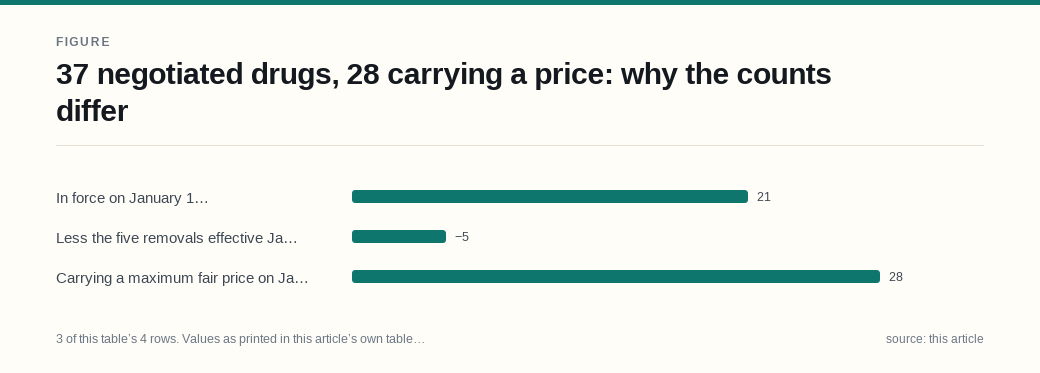
37 negotiated drugs, 28 carrying a price: why the counts differ
CMS describes the third cycle as bringing “the total number of negotiated drugs to 37” — the 10 first-cycle drugs, the 15 second-cycle drugs, and these 13. Those three numbers add to 38, not 37. The difference is Tradjenta, which appears in both the 2027 and the 2028 lists because it was picked for renegotiation; CMS does not spell that out, and it is the only overlap we can identify between the lists.
The larger gap is between 37 and what a pharmacy will actually work from. On January 1, 2028:
| Count | Drugs |
|---|---|
| In force on January 1, 2027 (after the four 2027 removals) | 21 |
| Less the five removals effective January 1, 2028 | −5 |
| Plus the 12 drugs newly carrying a price (13 less Tradjenta, which was already counted) | +12 |
| Carrying a maximum fair price on January 1, 2028 | 28 |
So the right sentence is not “37 drugs have negotiated prices”. It is: 37 drugs have been through negotiation, and 28 will carry a maximum fair price on January 1, 2028. A deselection determination made after November 2, 2026 would not change that count for 2028: the fact sheet says a drug determined between November 2, 2026 and March 31, 2028 to have a generic or biosimilar in bona fide marketing keeps its price for 2028 and loses it on January 1, 2029.
Two selected drugs got no price, and Botox is on hold
The Xeljanz; Xeljanz XR group and Xolair were selected for this cycle and receive no maximum fair price. CMS’s stated reason is that, before the end of or during the negotiation period, it determined that at least one generic approved under section 505(j) of the Federal Food, Drug, and Cosmetic Act identifies Xeljanz or Xeljanz XR as its listed drug, and that at least one biosimilar licensed under section 351(k) of the Public Health Service Act identifies Xolair as its reference product, and that those products are subject to bona fide marketing. Both products have a removal date of January 1, 2029 on the deselection list, having never carried a price.
Botox and Botox Cosmetic are a different case. CMS selected them in January 2026, then states that they are “currently not being treated as a selected drug, consistent with the court order in AbbVie v. HHS, 1:26-cv-00431 (D.D.C.)”, and that the litigation “remains ongoing”. No price is published. We could not read the docket itself, so the case reference and the current position are attributed to CMS — the fact sheet’s first footnote for the litigation status, and the November 23 press release, which also names the case.
Tradjenta’s 2028 price is $3 above its 2027 price
Tradjenta is the program’s first renegotiation, and the number is worth stating plainly because it runs against the intuition that renegotiating drives a price down. Its maximum fair price was $78 for a 30-day supply in 2027, per the 2027 fact sheet. The price CMS lists for 2028 is $81.
Both figures are far below the $469 gross cost CMS reports for a 30-day supply in 2025 — an 83% reduction. But the direction is up, and CMS does not explain why in the fact sheet. One mechanical reason a price can rise is in the statute itself: for each year after a drug’s first applicability year, CMS updates the negotiated price by the annual percentage increase in the Consumer Price Index for all urban consumers (CPI-U), and a renegotiation runs alongside that update. We can verify both prices and the CPI-U rule; we cannot verify from the published documents how much of the $3 is the index and how much is the renegotiation.
What does not change
- Your 2027 costs. Every price above takes effect on January 1, 2028. Nothing in the November 23 announcement changes a 2027 premium, deductible or copay.
- Your 2028 premium, deductible or out-of-pocket cap. CMS has not published the 2028 Part D benefit parameters. The 2027 figures — a $700 standard deductible and a $2,400 annual out-of-pocket threshold — come from the rate announcement CMS published on April 6, 2026, and the 2028 equivalents will come in their own. An article that projects them now would be guessing.
- The ceiling-versus-copay distinction. The maximum fair price caps what a manufacturer may charge for a selected drug dispensed to someone with Medicare drug coverage. What you pay still runs through your plan: deductible, tier, copay or coinsurance, formulary and pharmacy network. Two people on the same drug in different plans can pay different amounts on the same day.
- Prices outside Medicare. The negotiated price does not set a cash price and does not govern what a commercial plan or an uninsured purchase costs.
- Which plans are sold where. Medicare is a federal program, but which Part D and Medicare Advantage plans are offered — and what they put on which tier — varies by state and county, so the plan-level detail has to come from your own plan’s materials.
The program itself remains contested, and has been since enactment: manufacturers have challenged it in court, and the statute limits administrative and judicial review of the Secretary’s price determinations. Everything above is what CMS has published; it describes the rules rather than taking a position on whether they are the right policy.
What should you do before December 7?
Medicare open enrollment for the 2027 plan year runs October 15 to December 7, 2026, per Medicare.gov, and every 2027 change takes effect on January 1.
- Check whether your drug is on the 13-drug list. If it is, do not assume your copay falls by the headline percentage. Enter your prescriptions and your plan into the Plan Finder on Medicare.gov and read the tier and cost-sharing line for the year you are choosing.
- If you take Farxiga, Januvia, Janumet, Ofev or Pomalyst, ask your plan or pharmacist which product is covered for 2028 and what it costs. The negotiated price ends on January 1, 2028 because a competing product exists; whether that saves or costs you money depends on the tier.
- Add the deductible and the out-of-pocket threshold to any comparison. A plan that looks cheaper on premiums can cost more once the deductible and tier placement are in. How the annual threshold works is in What Is the Medicare Part D Out-of-Pocket Maximum in 2027?.
- If your drug costs land early in the year, ask about the Medicare Prescription Payment Plan. Every Part D plan must offer it, participation is voluntary and free, and it spreads your out-of-pocket drug costs across the calendar year. It changes when you pay, not what you owe.
- Hang up on anyone who offers to “enroll you” in the new drug prices. There is no enrollment, no application and no fee — the price is the price the pharmacy charges, and Medicare does not call beneficiaries to confirm a drug price or to sell a drug plan. Open enrollment is peak impersonation season; the tells are collected in Medicare open enrollment 2027.
Bottom line
Thirteen drugs get negotiated prices on January 1, 2028, and five — Farxiga, Januvia, Janumet, Ofev and Pomalyst — lose theirs on the same day, which leaves 28 drugs carrying a maximum fair price even though CMS counts 37 as negotiated. The headline 45% and $9.2 billion describe a hypothetical 2025, not your 2028 bill, and the price CMS publishes is a ceiling on the manufacturer rather than the number at the counter. If you take one of the 13, the useful move is to price your actual plan for 2028 when its materials appear — and if you take one of the five, to ask now which product your plan covers. The 2027 decision still closes on December 7, 2026.
The earlier cycles are in Medicare’s second round of negotiated drug prices, the plan-shopping checklist is in Medicare open enrollment 2027, and a survey of the network’s guides is at omc.center/resources.
Frequently asked questions
- Will my drug cost less in 2028?
- Only if it is one of the 13 drugs in CMS's November 23, 2026 list, and even then the maximum fair price is a ceiling on what the manufacturer may charge — not your copay. What you pay still comes from your plan's deductible, the drug's tier, and your copay or coinsurance, so two people on the same drug in different plans can pay different amounts. Nothing in the announcement changes what you pay in 2027.
- I take Farxiga, Januvia, Janumet, Ofev or Pomalyst. What happens on January 1, 2028?
- The negotiated price stops applying, because CMS has determined that a generic or biosimilar naming the drug is approved or licensed and is being marketed. That is the statutory trigger for removal, not a policy reversal. The practical step is to ask your plan or pharmacist which product is the covered option for 2028 and what it costs — the generic may sit on a different tier with a different copay than the brand did.
- Is the $9.2 billion in savings money I will get back?
- No. That figure is a counterfactual: CMS calculates what Medicare would have saved in 2025 if these 13 prices had been in effect that year, measured against 2025 net spending. It is not a 2028 budget figure and it is not a payment to anyone. CMS's projection of what enrollees themselves would save in 2028 is $69 million for Part D and $395 million for Part B, under the defined standard benefit design.
- Why is Botox not on the list, when CMS selected it?
- CMS selected Botox and Botox Cosmetic for this cycle but states they are 'currently not being treated as a selected drug, consistent with the court order in AbbVie v. HHS, 1:26-cv-00431 (D.D.C.)', and that the litigation is ongoing. No price is published for them. Separately, Xeljanz, Xeljanz XR and Xolair were selected but get no price because CMS determined that a generic or biosimilar is approved or licensed and subject to bona fide marketing.
- Do these prices apply to drugs I get at a clinic or infusion center?
- For the first time, yes — this is the first cycle that includes Part B drugs, the ones a provider administers rather than a pharmacy dispensing. CMS reports that about 120,000 people with Part B coverage used the four selected drugs payable under Part B in 2025. For Part B, the price is applied through what CMS calls the HCPCS code dosage price for each dosage form and strength.
Sources
Each source is a primary or official reference, checked before publication. Links open the original.
- Centers for Medicare & Medicaid Services, 'Medicare Drug Price Negotiation Program: Negotiated Prices for Initial Price Applicability Year 2028' (fact sheet, November 2026) — the 13 drugs and their maximum fair prices for a 30-day supply, the 2025 Medicare gross cost for the same basis, the discount percentages, Part B and Part D expenditure and enrollee counts, the $9.2 billion / 45% and $5.5 billion / 33% savings estimates, the $69 million and $395 million enrollee projections, the timeline, and the footnotes on Xeljanz, Xeljanz XR, Xolair and Botox (cms.gov/files/document/fact-sheet-negotiated-prices-ipay-2028.pdf)
- CMS, 'CMS Announces Lower Negotiated Prices for 13 High-Cost Drugs' (press release, November 23, 2026) — the announcement itself, the 37-drug running total across the three cycles, and the 1.4 million Part D and 120,000 Part B enrollee figures (cms.gov/newsroom/press-releases/cms-announces-lower-negotiated-prices-13-high-cost-drugs)
- CMS, 'Selected Drugs and Negotiated Prices' (page last modified November 23, 2026) — the deselection determinations and removal effective dates, including Farxiga and Januvia (MFP applies 2026 and 2027), Janumet; Janumet XR, Ofev and Pomalyst (MFP applies 2027) with removal effective January 1, 2028, and Xeljanz; Xeljanz XR and Xolair with removal effective January 1, 2029 (cms.gov/initiatives/medicare-prescription-drug-affordability/overview/medicare-drug-price-negotiation-program/selected-drugs-negotiated-prices)
- CMS, 'Medicare Drug Price Negotiation Program: Negotiated Prices for Initial Price Applicability Year 2027' (fact sheet) — the 15 second-cycle drugs and prices, including Tradjenta's $78 maximum fair price for 2027 and the 2024 list-price basis that the 2028 fact sheet does not use, plus the CY 2024 enrollee counts for Janumet; Janumet XR, Ofev and Pomalyst (cms.gov/files/document/fact-sheet-negotiated-prices-ipay-2027.pdf)
- CMS, 'Medicare Drug Price Negotiation Program: Negotiated Prices for Initial Price Applicability Year 2026' (fact sheet) — the 10 first-cycle drugs and prices, including Januvia at $113.00 and Farxiga at $178.50 for 2026, with CY 2023 enrollee counts (cms.gov/files/document/fact-sheet-negotiated-prices-initial-price-applicability-year-2026.pdf)
- CMS, 'Selected Drug List MFP Data File' (ZIP) — the per-dosage-form and per-strength maximum fair prices that CMS says govern the price of an actual package rather than the 30-day-supply figure (cms.gov/files/zip/selected-drug-list-mfp-data-file.zip)
- Inflation Reduction Act of 2022, Public Law 117-169, sections 11001-11002 (August 16, 2022) — added sections 1191-1198 of the Social Security Act, 42 U.S.C. 1320f to 1320f-7, which establish the negotiation program, the maximum fair price, the annual CPI-U update, and the deselection trigger (govinfo.gov/content/pkg/PLAW-117publ169/html/PLAW-117publ169.htm)
- CMS, 'Medicare Drug Price Negotiation Program: Selected Drugs for Initial Price Applicability Year 2028' (fact sheet, January 27, 2026) — the 15 drugs selected for negotiation on that date, including Botox; Botox Cosmetic, and the selection spending and enrollee counts from November 2024 to October 2025 (cms.gov/files/document/factsheet-medicare-negotiation-selected-drug-list-ipay-2028.pdf)
- CMS, 'Announcement of Calendar Year (CY) 2027 Medicare Advantage Capitation Rates and Part C and Part D Payment Policies' (April 6, 2026), Table V-2 — the standard Part D deductible of $700 and annual out-of-pocket threshold of $2,400 for 2027, up from $615 and $2,100 in 2026 (cms.gov/files/document/2027-announcement.pdf)
- Medicare.gov, 'Joining a plan' — the Open Enrollment Period of October 15 to December 7 and what can be changed during it (medicare.gov/basics/get-started-with-medicare/get-more-coverage/joining-a-plan)
- Medicare.gov, 'Medicare drug coverage (Part D)' and 'What's the Medicare Prescription Payment Plan?' — what Part D plans cover and the monthly payment option for out-of-pocket drug costs (medicare.gov/health-drug-plans/part-d medicare.gov/prescription-payment-plan)