What Is the Medicare Part D Out-of-Pocket Maximum in 2027?
The 2027 Part D out-of-pocket cap is $2,400. What counts toward it, what does not, and what happens when you reach it — plus the $700 deductible.
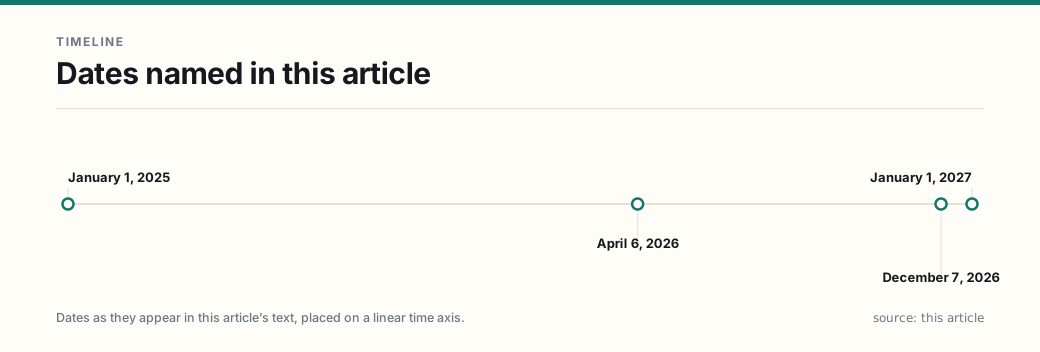
If you are choosing a drug plan before December 7 or budgeting prescriptions for next year, one number does most of the work: the most you can be required to pay out of pocket for covered Medicare Part D drugs in 2027 is $2,400. Reach that amount, and your plan pays the full cost of covered drugs for the rest of the calendar year. Premiums and drugs your plan does not cover sit outside that cap — but for the drugs themselves, the ceiling is real and applies in every plan.
What is the Part D out-of-pocket maximum in 2027?
The cap is the annual out-of-pocket threshold CMS sets under the Part D benefit rules — the number the program’s materials call the Part D out-of-pocket maximum. It was $2,000 in 2025 — the first year of the Inflation Reduction Act redesign — and it grows each year by a statutory formula rather than by a policy choice:
| Year | Annual out-of-pocket threshold | Standard deductible |
|---|---|---|
| 2025 | $2,000 | — |
| 2026 | $2,100 | $615 |
| 2027 | $2,400 | $700 |
The 2027 figures come from the rate announcement CMS published on April 6, 2026. The threshold’s formula is mechanical: the statute says the threshold for 2025 is $2,000 and for later years is the prior year’s amount increased by the annual percentage increase (API) — the growth in average per capita Part D drug spending. For 2027 the API was 13.65%, so $2,100 grew to roughly $2,387 and, under the statute’s rounding rule, to the nearest multiple of $50: $2,400. The standard deductible is updated from the same API under its own rounding rule — $615 x 13.65% rounds to the nearest multiple of $5, which is $700.
That threshold is not just a standard-benefit figure. Every Part D plan — and every Medicare Advantage plan with drug coverage — operates against it, and Medicare.gov states the deductible limit the same way: no Medicare drug plan may have a deductible more than $700 in 2027. A plan can cost you less; it cannot raise the ceiling.
How do the three phases work in 2027?
Since the redesign took effect on January 1, 2025, Part D has three phases — the coverage gap, the old “donut hole,” was eliminated:
- Deductible stage. If your plan has a deductible, you pay the full cost of covered drugs until it is met. Some plans have no deductible, and two categories skip it entirely: ACIP-recommended adult vaccines carry no deductible and no cost sharing at all, and covered insulin products are exempt from the deductible with cost sharing capped at $35 for a month’s supply in 2027 — possibly less, because for 2026 and later years the statute caps the insulin copayment at the lowest of $35, 25% of the negotiated price, or 25% of the maximum fair price.
- Initial coverage stage. After the deductible, you pay cost sharing until your qualifying spending reaches the threshold. Under the standard benefit that is 25% coinsurance for generic and brand-name drugs; your own plan may use fixed copayments or different percentages by tier instead, and its 2027 materials control.
- Catastrophic coverage stage. Once your qualifying out-of-pocket spending on covered Part D drugs reaches $2,400 — including certain payments made on your behalf, such as through Extra Help — you are moved to catastrophic coverage automatically, and you pay nothing out of pocket for covered Part D drugs for the rest of the calendar year. No charge at the counter, through December 31.
What the cap does not touch: your monthly premium, drugs your plan does not cover, drugs Medicare pays for under Part B (infusions and injections given in a clinic), and your medical costs generally. The cap is a drug-cost ceiling, not a health-cost ceiling.
What counts toward the $2,400 — and what does not?
The threshold counts what the statute calls incurred costs for covered Part D drugs, and Medicare.gov summarizes it as “out-of-pocket spending on covered Part D drugs… including certain payments made on your behalf.”
Counts toward the $2,400:
- Your deductible payments, copayments and coinsurance for covered drugs.
- Amounts paid by a family member or anyone else on your behalf.
- Payments by Medicare’s Extra Help program, a State Pharmaceutical Assistance Program, an AIDS Drug Assistance Program, or the Indian Health Service or a tribal or urban Indian organization.
- Since 2025, amounts reimbursed by other insurance or an employer group health plan — with two explicit exceptions: the plan’s own basic Part D coverage and payments under the Manufacturer Discount Program do not count.
Does not count:
- Your monthly premium.
- Spending on drugs outside your plan’s formulary or otherwise not covered.
- Part B drugs and medical costs.
The last rule has a practical edge: if your plan does not cover a drug, the money you spend on it neither counts toward the cap nor gets you closer to $0 cost sharing. Before paying cash price for a drug your plan excluded, check whether the plan covers an alternative on formulary — or whether a formulary exception request would work.
Who reaches the cap faster?
Three groups hit $2,400 sooner than the standard design suggests:
- People on expensive specialty drugs. At 25% coinsurance, a drug costing $3,000 a month puts you at the cap in about three months by itself — after which the drug costs nothing for the remaining months. The redesign that created this $2,000-to-$2,400 ceiling took effect on January 1, 2025; §1860D-2(b)(4)(B)(i)(VII) of the Social Security Act sets the 2025 threshold at $2,000 and grows it annually from there.
- People with Extra Help. The low-income subsidy eliminates the deductible and fixes copayments — in 2027, at most $1.65 for a generic or preferred multi-source drug and $5.00 for other drugs if your income is at or below 100% of the federal poverty level, or $5.80 and $14.40 between 100% and 150%. Those copayments count toward the threshold just like your own payments would, so heavy drug users with Extra Help reach catastrophic coverage and stop paying entirely.
- People whose other coverage pays. Because third-party payments from the listed programs and (since 2025) most other insurers count as incurred costs, a beneficiary whose employer plan or assistance program pays the cost sharing can accumulate toward the threshold even while paying little personally.
If you are not sure whether you qualify for Extra Help: Medicaid, any Medicare Savings Program, or Supplemental Security Income eligibility qualifies you automatically, and if you don’t qualify automatically you can apply.
Can I spread the costs across the year?
Yes. The Medicare Prescription Payment Plan exists precisely for the person whose drug costs land heavily in January and February. Every Part D plan and Medicare Advantage plan with drug coverage offers it, participation is voluntary, and there is no cost to participate.
How it works: instead of paying the pharmacy, you get a monthly bill from your plan that spreads your out-of-pocket costs for covered drugs across the calendar year. The monthly amount is capped by a statutory formula — in the first month, the remaining threshold minus what you have already incurred, divided by the months left in the year — so your bill never exceeds that calculated cap and often comes in lower if your actual costs were smaller. Two limits matter: it changes when you pay, not what you owe, and missing a billed month can terminate the election.
It is worth considering if your prescriptions will hit the $2,400 cap early in the year — you would pay a predictable monthly amount instead of a $700 deductible and 25% coinsurance in the first months, then nothing. If your drug costs are low and steady, it changes little.
What to check before December 7
Open enrollment runs October 15 to December 7, 2026, and every plan change takes effect January 1.
- Compare the whole ladder, not the premium. In the Plan Finder on Medicare.gov, enter your drugs and read each plan’s deductible, tier copays, and estimated annual out-of-pocket total. A $0-premium plan with a $700 deductible and 25% coinsurance can cost more than a pricier plan with lower cost sharing.
- Read your plan’s Annual Notice of Change for the 2027 deductible, tier structure, and any formulary changes — plan-specific numbers can be lower than the standard amounts but never higher on the deductible or threshold.
- Check the EOB line. Your plan’s monthly Explanation of Benefits shows your coverage stage and what counts toward your out-of-pocket total — the running number to watch against $2,400.
- If you expect high early-year drug costs, opt into the Payment Plan with your plan for 2027 — you can elect it during open enrollment or any month of the year.
- If income or assets changed, check Extra Help eligibility — the $0 deductible and fixed copays can beat even catastrophic coverage for out-of-pocket costs.
Bottom line
The Medicare Part D out-of-pocket maximum for 2027 is $2,400 for covered drugs — up from $2,100 in 2026 by the statutory growth formula — and once you reach it, covered drugs cost $0 through December 31. Premiums, non-covered drugs and Part B drugs sit outside the cap; payments by Extra Help, state programs and (since 2025) most other insurers count toward it. The maximum deductible any plan may charge is $700. Check your own plan’s numbers in the Plan Finder before December 7, 2026.
The plan-shopping checklist is in Medicare open enrollment 2027, how the negotiated prices interact with these numbers is in Medicare’s second round of negotiated drug prices starts January 1, 2027, the premium side of the 2027 changes is in Medicare Part B premium 2027, and a survey of the network’s guides is at omc.center/resources.
Frequently asked questions
- What is the Medicare Part D out-of-pocket maximum in 2027?
- $2,400. That is the annual out-of-pocket threshold for covered Part D drugs in every Medicare drug plan in 2027, up from $2,100 in 2026. Once your qualifying costs for covered Part D drugs reach $2,400, you pay nothing out of pocket for those drugs for the rest of the calendar year. Premiums and drugs your plan does not cover are outside the cap.
- Do my Part D premiums count toward the $2,400 cap?
- No. The threshold counts true out-of-pocket costs, which CMS defines as spending on covered Part D drugs made by you or on your behalf by certain third parties. Your monthly premium is not drug spending, so it never counts — and neither do medical costs, drugs outside your plan's formulary, or Part B drugs.
- Is the out-of-pocket maximum the same in every Part D plan?
- The threshold itself is: no plan can set the 2027 annual out-of-pocket threshold above $2,400, because the amount is set annually by statute. What differs by plan is how quickly you get there — a plan with no deductible or lower copays gets you to the cap sooner than the standard-benefit design.
- Do payments made on my behalf count toward the cap?
- Yes. Payments from Medicare's Extra Help program, State Pharmaceutical Assistance Programs, AIDS Drug Assistance Programs, the Indian Health Service, and amounts paid by family members on your behalf all count toward the threshold. Since 2025, amounts reimbursed by other insurance or an employer health plan also count, with two exceptions: the plan's own basic Part D coverage and manufacturer discounts do not.
- What happened to the Part D donut hole?
- It is gone. The Inflation Reduction Act eliminated the coverage gap phase on January 1, 2025, and replaced the old discount program with the Manufacturer Discount Program. Part D now has three phases — deductible, initial coverage, and catastrophic coverage — and the catastrophic phase costs you $0 for covered drugs for the rest of the year.
- Can I spread my Part D out-of-pocket costs over the year?
- Yes, through the Medicare Prescription Payment Plan. Every Part D plan and Medicare Advantage plan with drug coverage offers it, participation is voluntary, and there is no cost to join. It spreads your out-of-pocket costs for covered drugs across the calendar year in monthly bills that never exceed a calculated monthly cap — it changes when you pay, not what you owe.
Sources
Each source is a primary or official reference, checked before publication. Links open the original.
- CMS, 'Announcement of Calendar Year (CY) 2027 Medicare Advantage Capitation Rates and Part C and Part D Payment Policies' (April 6, 2026), Attachment V, Tables V-1, V-2 and V-6 — the 2027 deductible ($700), annual out-of-pocket threshold ($2,400), 25% initial-coverage coinsurance, the LIS copayments, and the update formula ($2,100 x 13.65% API, rounded to the nearest $50) (cms.gov/files/document/2027-announcement.pdf)
- Medicare.gov, 'How much does Medicare drug coverage cost?' — the $700 maximum deductible for 2027, the 25% initial-coverage coinsurance, the $2,400 threshold including payments made on your behalf, and the automatic catastrophic coverage with $0 for covered Part D drugs (medicare.gov/drug-coverage-part-d/costs-for-medicare-drug-coverage/costs-in-the-coverage-gap)
- Social Security Act section 1860D-2(b)(4), 42 U.S.C. 1395w-102 — the threshold amounts ($2,000 for 2025, increased annually by the annual percentage increase) and the incurred-cost rules, including the payments that count toward the threshold (law.cornell.edu/uscode/text/42/1395w-102)
- Social Security Act section 1860D-2(b)(8) and (b)(9), 42 U.S.C. 1395w-102 — ACIP-recommended adult vaccines carry no deductible and no cost sharing; covered insulin products are exempt from the deductible and capped at the applicable copayment amount ($35, or 25% of the negotiated price or maximum fair price if lower, for 2026 and later years)
- CMS, 'Final CY 2025 Part D Redesign Program Instructions Fact Sheet' — the three-phase design, the $2,000 threshold for 2025, TrOOP as spending on covered Part D drugs made by the beneficiary or certain third parties, and the Manufacturer Discount Program replacing the Coverage Gap Discount Program (cms.gov/newsroom/fact-sheets/final-cy-2025-part-d-redesign-program-instructions-fact-sheet)
- Inflation Reduction Act of 2022, Public Law 117-169, section 11201 — the Part D benefit redesign and the manufacturer discount program (govinfo.gov/content/pkg/PLAW-117publ169/html/PLAW-117publ169.htm)
- Medicare.gov, 'What's the Medicare Prescription Payment Plan?' — all plans offer the option, participation is voluntary, and there is no cost to participate (medicare.gov/prescription-payment-plan)
- CMS, 'Medicare Prescription Payment Plan Part 1 Guidance' — the first-month and subsequent-month maximum monthly cap calculations (cms.gov/files/document/medicare-prescription-payment-plan-part-1-guidance.pdf)
- CMS, 'Medicare & You 2027' (Product No. 10050) — the open enrollment window (October 15 to December 7, 2026), the January 1, 2027 coverage start, and the Plan Finder at Medicare.gov/plan-compare (medicare.gov/publications/10050-medicare-and-you.pdf)