Medicare's immigration-status cutoff: what the SSA notice means and the February 1, 2027 deadline
Medicare eligibility is now limited to four groups under a 2025 law. What an SSA notice means, the February 1, 2027 cutoff, and the 60-day appeal window.
Medicare eligibility is now limited to four immigration groups under section 71201 of Public Law 119-21, a federal law enacted on July 4, 2025, and the Social Security Administration (SSA) began sending an estimated 300,000 preliminary notices in November 2026 to enrollees whose records could not confirm they still qualify. If you receive one, you have until your coverage ends — generally February 1, 2027 — to provide evidence, and 60 days after a termination or denial letter to appeal in writing.
What changed, and when
The law amended title XVIII of the Social Security Act by adding section 1899C (42 U.S.C. 1395mmm), which limits who can be entitled to or enrolled for Medicare. The rule that implements it was finalized by the Centers for Medicare & Medicaid Services (CMS) in its Calendar Year 2027 Physician Fee Schedule final rule (FR Doc. 2026-22743, published in the Federal Register on November 9, 2026, effective January 1, 2027).
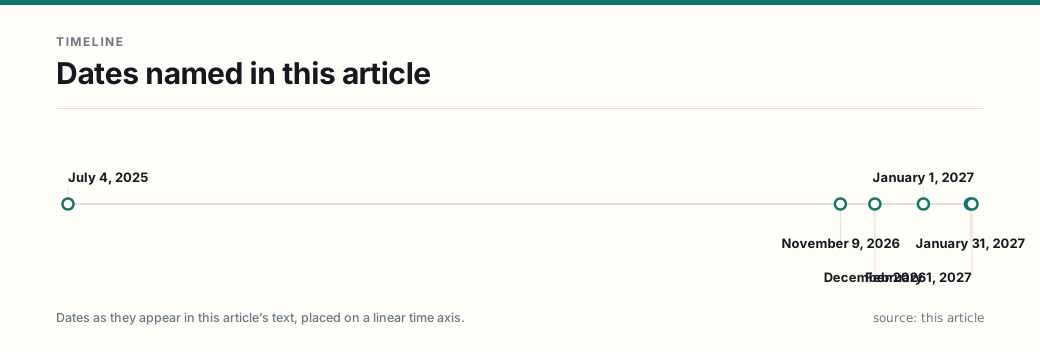
The timeline that matters to current enrollees:
- July 4, 2025 — the law is enacted. Noncitizens who were already entitled to or enrolled for Medicare on that date, and who did not hold one of the qualifying statuses, became what the rule calls the “grace period population.”
- November 2026 — the SSA sends preliminary notices (an estimated 300,000) to everyone whose records do not immediately confirm eligibility, whether or not they are actually affected.
- December 2026 — people who do not establish continued eligibility receive a formal termination notice. CMS plans its own notice to affected people the same month.
- January 31, 2027 — the last day of Medicare coverage under the new rules. Coverage “will generally remain in effect through January 31, 2027,” per the SSA.
- February 1, 2027 — coverage termination takes effect.
Who can still get Medicare under the new rules
Section 1899C allows Medicare only for:
- U.S. citizens and nationals.
- Lawful permanent residents (green card holders).
- Cuban and Haitian entrants, as defined in section 501(e) of the Refugee Education Assistance Act of 1980.
- Individuals lawfully residing in the United States under the Compacts of Free Association — citizens of the Federated States of Micronesia, the Republic of the Marshall Islands, or the Republic of Palau.
Everyone else is outside the law’s eligibility list, even with a lawful status and decades of Medicare payroll taxes. Groups the Medicare Rights Center names as affected include refugees, people with pending asylum applications, people with temporary protected status, and trafficking victims and other victims of crime. The law also does not change Social Security benefit eligibility or payment rules: a notice about Medicare does not, by itself, affect retirement or disability checks.
Why you might get a notice even if you are eligible
The notice pool is deliberately broader than the affected population. The SSA’s estimate of roughly 300,000 preliminary notices covers all Medicare enrollees whose records do not immediately confirm compliance — not just the people expected to lose coverage. CMS’s own estimate is that approximately 32,000 people will lose Medicare beginning in 2027, while the Congressional Budget Office estimated, in 2025, about 100,000 (a figure the Medicare Rights Center cites; the final rule acknowledges the two estimates may differ and that “the actual number who lose coverage remains unknown” because notice recipients get a chance to submit documentation).
The practical takeaway: a preliminary notice is a records problem, not a verdict. If your status qualifies but SSA records are stale or incomplete, the fix is paperwork, not panic.
What to do if you receive a notice
The SSA’s published instructions, which also appear in the notice itself:
- Read the notice carefully. It explains what steps, if any, you need to take.
- Upload documents digitally through a my Social Security account (www.ssa.gov/myaccount), using “Upload Documents.”
- Call 1-844-507-7131 if you live in the United States, or 855-522-6939 if you live outside it.
- Bring documents to a local Social Security office.
Documents that establish eligibility include a U.S. passport or Certificate of Naturalization for citizenship, or a Permanent Resident Card (I-551), Arrival/Departure Record (I-94), or Employment Authorization Document (I-766) for immigration status.
If coverage is terminated or denied anyway, you can appeal in writing within 60 days of the decision letter — the SSA accepts its online non-medical appeal form or Form SSA-561-U2 (Request for Reconsideration).
If you do lose Medicare: the paths that remain
- A 12-month special enrollment period (SEP). CMS finalized an SEP for people whose coverage ended under the new rules and who later regain a qualifying status (or whose status changes to a qualifying one). It runs for 12 months starting the month you contact the SSA with sufficient evidence, and you may choose retroactive coverage limited to six months or prospective coverage.
- Your Social Security benefits continue. Only Medicare entitlement or enrollment is affected; title II retirement and disability payments are not.
- Alternative coverage varies by state and by circumstance. The SSA suggests checking your state’s Social Services office (some states help immigrants who cannot get federal health benefits), a workplace health plan through your or a spouse’s employer, and community health centers for free or low-cost care. What is available depends on where you live and your status — there is no single national replacement program.
- Call 1-800-MEDICARE with Medicare questions; CMS’s December 2026 notice points affected enrollees there and offers assistance in 14 languages.
What both sides say
The politics of this law are contested, and both readings are worth stating plainly. The position reflected in CMS’s final rule is that the agency is implementing the eligibility framework Congress enacted, and that the notice sequence, the 12-month special enrollment period, and outreach in 14 languages are intended to mitigate harm to people caught by the change. Advocacy organizations, including the Medicare Rights Center, counter that ending coverage for people who paid Medicare taxes for decades will cause harm regardless of process. This guide takes no position on the dispute; what follows is the part that is verifiable and actionable either way.
The scam warning — read this before you respond to anyone
A wave of official-looking mail and a confused population is precisely the environment fraudsters work in. The rules that keep you safe here are simple:
- Real notices come from the SSA by mail and direct you to ssa.gov. No federal agency calls, texts, or emails you first to demand your Medicare number, Social Security number, bank details, or a fee. Anyone who does is not the government.
- There is no charge to submit documents or appeal. Uploading evidence, calling SSA, and filing Form SSA-561-U2 are all free.
- Verify before you act. If a message says your Medicare ends unless you “verify” something through a link, do not use the link — go to ssa.gov or medicare.gov yourself, or call the numbers above. Our guide to verifying government communications, Is That Really America.gov? A Scam-Spotting Checklist, covers the general habits.
- Help is free if you qualify. State Health Insurance Assistance Programs (SHIPs) — counselors CMS has briefed on these changes — provide no-cost Medicare counseling.
FAQ
Does this affect U.S. citizens? No. The new rules concern citizenship and immigration status only. A citizen’s Medicare eligibility is unchanged.
I’m a green card holder who has paid Medicare taxes for 20 years. Am I affected? Lawful permanent residents remain on the eligibility list. You should only hear from the SSA if its records cannot confirm your status — respond to that notice with your I-551 and the matter should close.
My Medicare is ending but my Social Security check is not. Is that a mistake? No. The law only limits Medicare. Section 1899C does not touch Social Security benefit eligibility or payment rules, and the SSA says its notices distinguish the two.
What if my immigration status changes after February 1, 2027? Contact the SSA at that point. CMS finalized a 12-month special enrollment period for people who regain a qualifying status, with the option of retroactive coverage up to six months.
How many people will actually lose coverage? Estimates conflict, and CMS says so: its Office of the Actuary projects about 32,000 beginning in 2027; the Congressional Budget Office previously estimated about 100,000. The roughly 300,000-person notice pool is larger than either figure precisely because many recipients will establish eligibility with documents.
Bottom line
Medicare eligibility is now limited to U.S. citizens and nationals, lawful permanent residents, Cuban and Haitian entrants, and Compact of Free Association migrants, under section 1899C of the Social Security Act. An estimated 300,000 preliminary notices are being sent from the SSA in November 2026; a notice is a request for evidence, not a final decision. Respond through ssa.gov, the phone numbers in your notice, or a local office; if coverage is terminated, you have 60 days to appeal in writing; and coverage for people who cannot establish eligibility generally ends February 1, 2027. If your status later becomes qualifying again, a 12-month special enrollment period is the path back in.
For what Medicare costs in 2027, see our 2027 Medicare premium guide; for the enrollment mechanics, see our guide to Medicare enrollment through America.gov.
Sources
Each source is a primary or official reference, checked before publication. Links open the original.
- Social Security Administration, 'Changes to Medicare Eligibility - Working Families Tax Cuts' — the four remaining eligibility groups, notice instructions, document list, 60-day written appeal, and the January 31, 2027 coverage end — www.ssa.gov/benefits/medicare/eligibility/
- Centers for Medicare & Medicaid Services, 'Medicare and Medicaid Programs; CY 2027 Payment Policies Under the Physician Fee Schedule...' final rule (FR Doc. 2026-22743), published in the Federal Register on November 9, 2026, effective January 1, 2027 — implements new section 1899C of the Social Security Act; states the SSA's estimate of approximately 300,000 preliminary notices in November 2026, the December 2026 termination notice, the February 1, 2027 effective date, the finalized 12-month special enrollment period with retroactive coverage limited to six months, and the CMS Office of the Actuary estimate of approximately 32,000 people losing coverage beginning in 2027 — www.federalregister.gov/documents/2026/11/09/2026-22743/medicare-and-medicaid-programs-cy-2027-payment-policies-under-the-physician-fee-schedule-and-other
- Public Law 119-21 (enacted July 4, 2025), section 71201, 'Limiting Medicare Coverage of Certain Individuals' — adds section 1899C (42 U.S.C. 1395mmm) to the Social Security Act — www.govinfo.gov/content/pkg/PLAW-119publ21/html/PLAW-119publ21.htm
- Medicare Rights Center, 'Thousands More Medicare Beneficiaries at Risk of Losing Coverage' (November 12, 2026) — attributes the Congressional Budget Office estimate of about 100,000 affected people and describes the finalized 12-month special enrollment period — www.medicarerights.org/medicare-watch/2026/11/12/thousands-more-medicare-beneficiaries-at-risk-of-losing-coverage